

Infect a Host
Main modeThe big green button on the main menu: infect a host and push through eight organs, from the Nasal Passage to the Brain, one boss at a time. Every finished run becomes a generation of your lineage.

Infect Game Mode is the heart of it. Pandemic Game Mode takes your virus around a living world map. Endless Game Mode asks how long you can last. Plus the Codex, controls, settings and sound.
The main mode
Infect a host and fight organ by organ, from the nose to the brain. It's the only Game Mode that earns XP and grows your lineage.
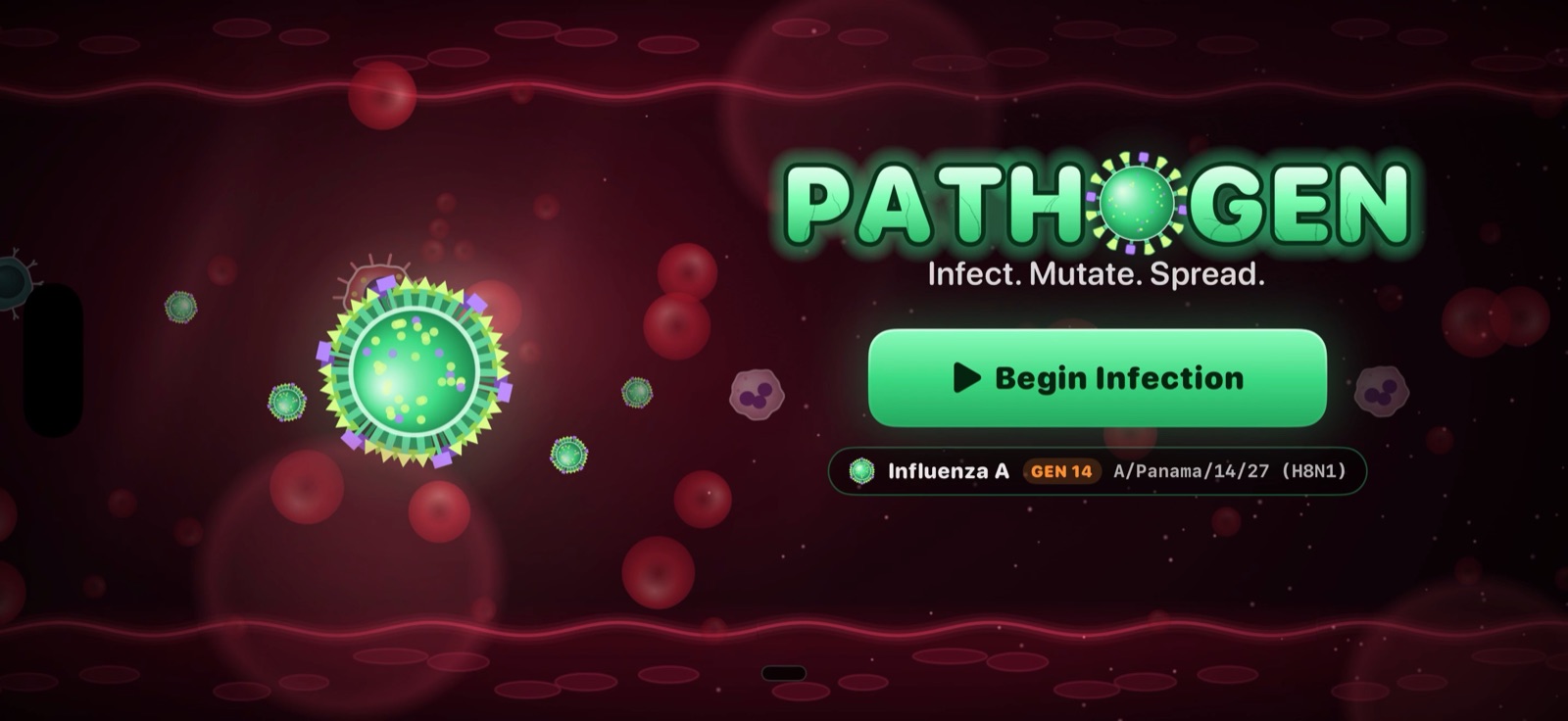
The big green button on the main menu: infect a host and push through eight organs, from the Nasal Passage to the Brain, one boss at a time. Every finished run becomes a generation of your lineage.

Once your lineage has pushed deeper, you can start a run in any organ it has reached instead of the nose. Backing out costs nothing, since modifiers are only used once the run begins.
Starting past the first organ opens a draft of traits to make up for the organs you skipped. Deeper starts roll rarer traits, and cards flag the synergies a pick would complete.

Every run opens with INFECTED slamming in over a green pulse while the game picks your host. Usually it's a person, but sometimes you land in an animal, which adds it to the Codex.

The first time any of your viruses reaches an organ, a welcome card shows what it unlocked: a new gear tier, the boss's named set and a new place to start future runs.

Before you descend, the game asks you to confirm, because there's no coming back. It counts unexplored rooms, warns about loot left on the floor, and flags any living tumor that will spread deeper.
Pausing opens two tabs. Run covers everything about the run you're in, from your host and traits to loot, modifiers and challenges, while Settings changes sound, vibration, language and controller without leaving.
Quit a run from the pause menu at any time and keep everything you collected. Abandoning doesn't end a generation either: it simply plays again next run with the same mutation.

The first page of every run's summary shows how it went and what it earned: nucleotides, materials, gear, new Codex entries, XP, and the permanent legacy bonus your generation leaves behind.

Every piece of gear the run found, sorted by rarity and compared with what you already wear. Equip the upgrades straight from the summary and dismantle the rest for nucleotides.
After a finished Infect Game Mode run you choose the mutation your next generation is born with, from boons, curses or a mix. Pick the same strain again to stack it, and some mutations turn your lineage into another virus.
Beat the Brain's boss and the ending plays: every organ lights up in turn along a spreading line of infection, and the immune system has nothing left to send. The host is yours.

On a new save your special buttons arrive one at a time, so there's less to learn at once. Shift, your signature ability, shows up after your first finished run, with the Ultimate soon after.
Between runs
The screens around your runs: the title, a main menu that grows with you, your family tree, and challenges that pay out every day.
The game opens inside a capillary: blood cells stream past, immune cells patrol, and your virus hangs backlit in its equipped skin, with its first progeny circling it.
PLAY on the left, LEVEL UP on the right, and your current virus in the middle. Every button shows what's waiting for you, from upgrades to unlock to skill points and new gear.
A new player sees only Infect a Host. Every other feature appears as you level up, one coming-soon teaser at a time, wearing a NEW tag until you visit it.
Pandemic Game Mode, Endless Game Mode and Run Modifiers each announce themselves with a NEW FEATURE UNLOCKED card explaining what the feature does, what makes it special and where to find it.
Everything you've collected sits in one chip. Tap any resource anywhere and a guide explains what it is and where it drops, with links to the matching Codex entry.

Your lineage drawn as a tree: one lane per virus, generations running left to right, each showing its look and mutation. Tap a generation to see its strain and the traits it picked.
Every generation passes a little of itself down. The Inherited panel lists each bonus your lineage has built up and how close it is to its cap.

Four tabs of goals: Rewards, Daily, Weekly and Milestones. Finishing them pays nucleotides, materials, gear, XP and skill points, and a banner pops up wherever you are when one completes.
Every day brings a fresh Easy, Normal and Hard challenge, refreshed at local midnight and drawn from a large pool, with a countdown to the next batch.
Every Monday brings a fresh Normal, Hard and Elite challenge: bigger goals than the dailies, with richer rewards to match.
Long-term goals in chains of steps, filtered by group, from Combat and Bosses to Hazards and Gear. Organ milestones are front-loaded with bonus skill points to speed up early progress.
What a challenge pays depends on its difficulty, from Easy up to Legendary. Harder tiers add chaperones, guaranteed gear and even skill points on top of nucleotides, shards and XP.
Story mode
Infect a city one person per run while its politicians, doctors and citizens fight back, then take whole continents and finally the world.
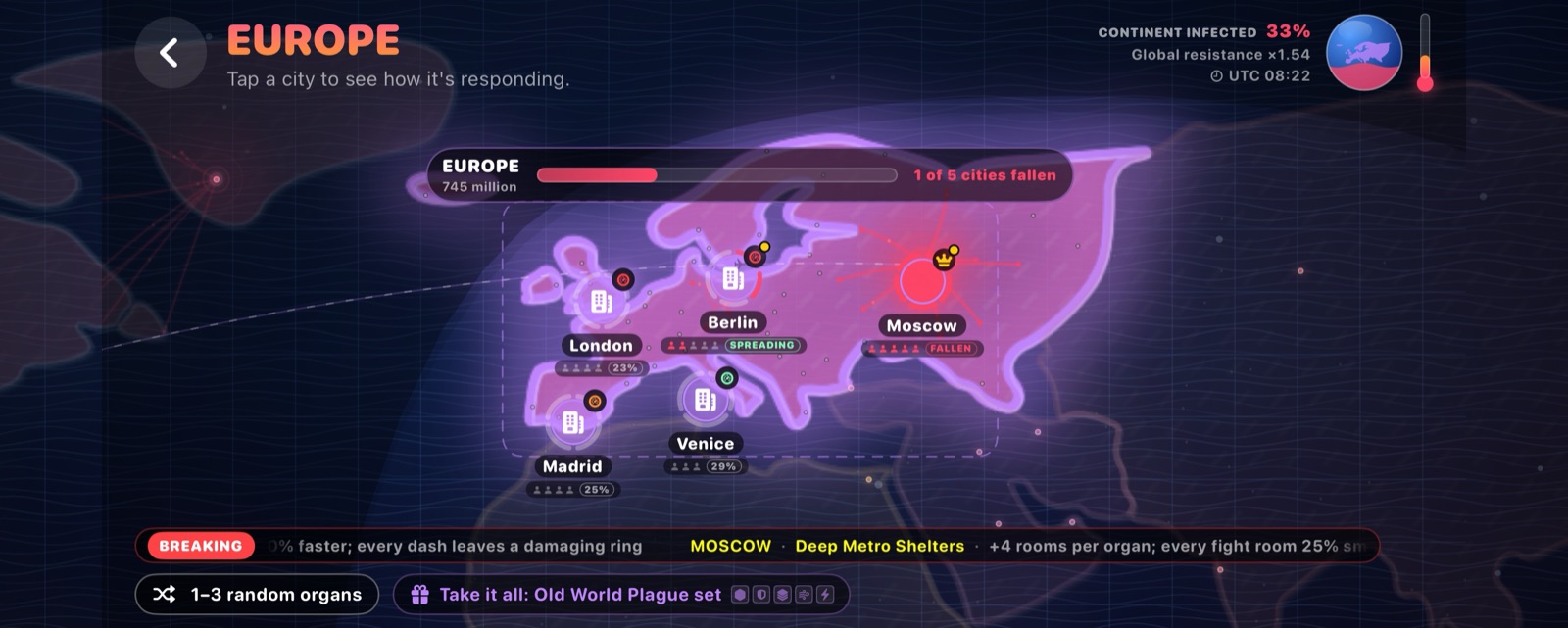
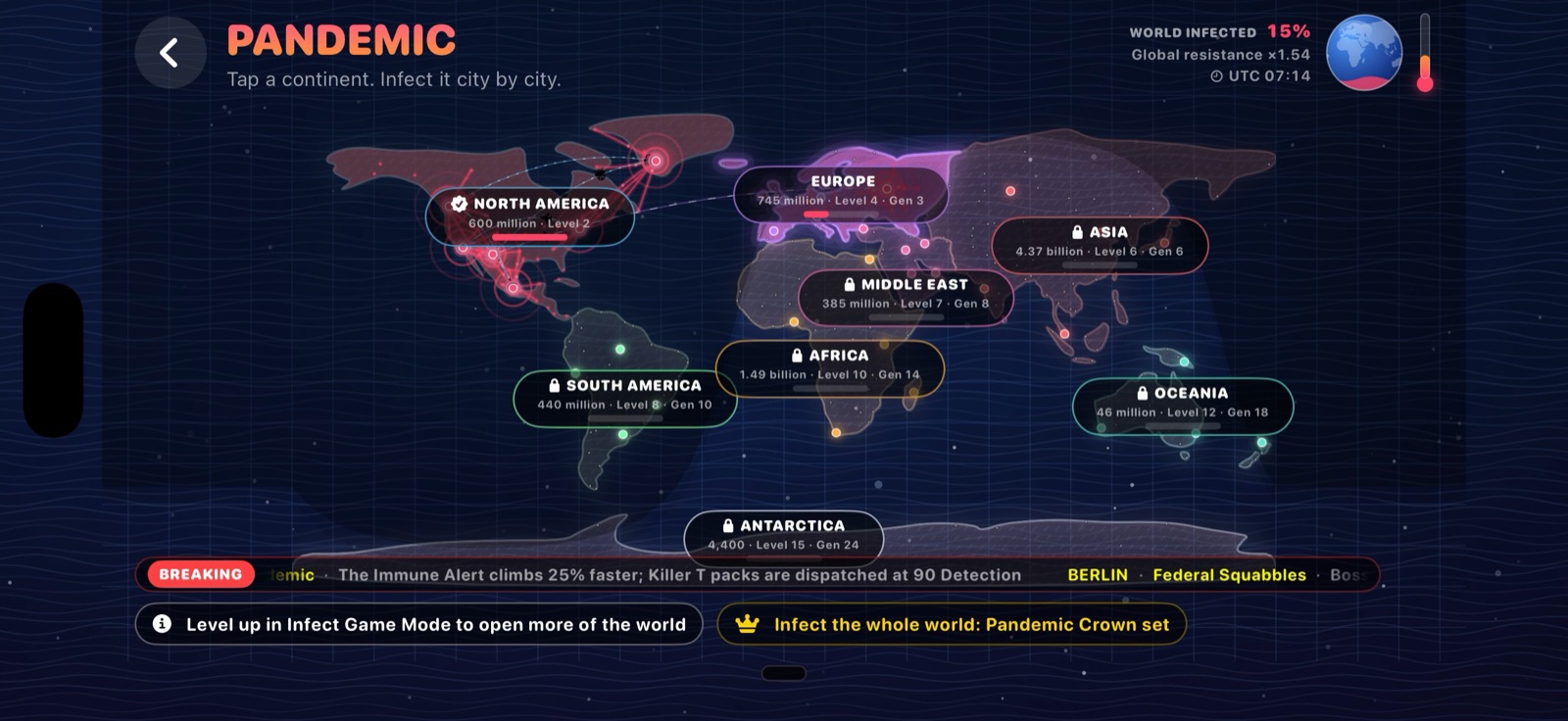
The story mode: infect the world city by city for rewards you can't get anywhere else. It's the only Game Mode where RNA drops, which pays for advanced Petri Lab upgrades and skill respecs.
Continents open one after another as your best virus levels up and grows its lineage in Infect Game Mode, starting with North America and ending with Antarctica. Each city opens with its continent.
Each successful run infects one person, and once enough people are infected the city falls. A failed run infects nobody but keeps its rewards, and fallen cities can be infected again.
Each run drops you into a random organ for a few organs and ends when the last boss falls. Difficulty and loot follow the deepest organ you've reached in Infect Game Mode.
Starting a city commits you to its continent, and every other continent waits until all of its cities have fallen. You can still zoom in on any continent and read what's coming.

Every city and continent you take makes the rest of the world fight harder, with tougher, harder-hitting immune cells. A fever thermometer beside the map shows how hot the world is running.
Every city answers your spread with responses that switch on as its infection gauge fills, from a standing policy to a lasting aftermath. Continents and the world answer too, and it all stacks.
Each place reacts at its own pace. Fast cities like Tokyo and Berlin bring their responses forward, slow ones like Moscow and Lagos hold them back, and every city pin wears a speed badge.
Politicians can help or hurt the virus, doctors mostly hurt it, and the people react in their own way, like Celebrity Denial in Los Angeles or Carnival Goes Ahead in São Paulo.
Every response card carries a tag for what it changes: the organ map, the immune cells, the boss fight, a twist on the rules, or a plain stat bonus or penalty.
Each response either helps the virus, shown in green with a heart, or hurts it, in orange with a warning sign. Across the world the two are split almost evenly.

Every person, city, continent and the world itself pays out in RNA, materials and gear. Each continent also gives a Legendary set found nowhere else, and the whole world awards a Prismatic one.
A living map: tap a continent to zoom in and a city to see how it's responding. Infection veins spread between cities, and a night side full of city lights sweeps around the globe.
Everything about a city on one card: its skyline and population, how fast it reacts, any weather in force, and a timeline showing where each response switches on.
A marquee along the bottom of the map lists every response in force, newest first, with unread ones in yellow. Tap a paused headline to jump straight to its city.
Each city's pin shows its progress at a glance: a ring with one segment per person that turns red as they're infected, a speed badge, and a crown once the city falls.
The run ends on the city's continent: its people flip red one by one, new responses flip in, and a FALLEN stamp lands when the city is taken.

Hosts are locals with names from their city, and the animals on its streets really live there, from camels in Cairo to kangaroos in Perth and penguins at McMurdo.
Pandemic Game Mode
Each continent brings its own cities, its own continent-wide responses and its own Legendary gear set. The Middle East, carved out of Asia, counts as one.

The first continent to open, with cities from New York and Los Angeles to Nuuk. Take it all and you earn the Liberty Strain, a Legendary set found nowhere else.
Cities from London and Madrid to Venice, Berlin and Moscow. Conquer them all for the Old World Plague set, and expect the borders to close as Europe falls.

A huge continent of cities, from Tokyo and Beijing to Mumbai, Novosibirsk and Singapore. Take them all for the Silk Road Vector set while Asia hardens its defenses against you.
Cities from Istanbul and Tehran to Baghdad, Riyadh and Dubai, carved out of Asia as a continent of its own. Taking all of them earns the Incense Caravan set.
Cities from São Paulo and Buenos Aires to Lima and Manaus, a continent whose responses lean in your favour. Take it whole for the Rainforest Canopy set.

Cities from Cairo and Lagos to Nairobi, Cape Town and Antananarivo. Africa's continent responses mostly help the virus, and taking it all earns the Cradle Genome set.
Cities from Sydney and Auckland to Perth and Port Moresby, a sparse population behind fortress borders. Take it whole for the Reef Bloom set.

The last continent: remote research stations seen from above the South Pole, with more people to infect than anywhere else. Take them all for the Permafrost Relic set.
Pandemic Game Mode
Every playable city, with how fast it reacts and the responses it throws at you. Each one's Codex entry tells a real outbreak or event from its history.
New York reacts at a steady pace. City That Never Sleeps fills its crowded streets with nucleotides, but once it falls North Brother Island, where Typhoid Mary was quarantined, sends Killer T packs after you.

A steady city where Freeway Sprawl stretches every fight room and Celebrity Denial lets Detection cool off fast. Once it falls, Wildfire Smoke Season shrouds every run there in smog.

A slow-reacting city whose metro rush hour squeezes fights into narrow tunnels. Thin mountain air saps your health later on, and once it falls Contingencia Ambiental grows a tumor in every organ.

A very fast responder whose Universal Healthcare lets wounded cells regenerate. Rainy-season gatherings slow every shot, and once it falls Granville Island Market adds a second Upgrade Chamber to every organ.

Tiny Nuuk, in Greenland, reacts slowly, and its Tiny Health Service means the host rarely reaches for medicine. Sea fog closes in later, and once it falls a drop shaft opens in every organ.

A slow border city where Paso del Norte lets your shots pierce. Star on the Mountain starts runs with your Ultimate charged, and once it falls, local food leaves every host well-fed and your attacks healing.
A fast-reacting city where the Packed Underground speeds up your shooting. Nightingale Hospitals thicken boss shields, but once it falls the Broad Street Pump Map, after John Snow's cholera map, reveals every organ.
A steady city where Tapas Culture keeps you regenerating. Late-night terraces plunge runs into darkness, and once it falls Movida Madrileña brings mutation orbs more often, each with an extra trait to pick from.
The city that gave the world the word quarantine reacts slowly. Tourist Crowds pull pickups to you, Acqua Alta floods organs with mucus, and once it falls bosses lose their signature skill.
A very fast city whose open club scene charges your Ultimate quicker. Mass testing and a booster campaign push back hard, and once it falls Charité Hospital lets bosses heal from doses mid-fight.
A very slow city where Official Silence lets you pick off unaware cells without raising Detection. A bitter winter slows everything down, and once it falls deep metro shelters add extra, tighter rooms.
One of the fastest-reacting cities, where Mask Etiquette shields every cell. Rush-hour trains add a projectile and robots speed up boss attacks, and once it falls every host has an ageing immune system.

A slow city whose Dharavi Lanes squeeze fights into small rooms full of nucleotides. Festival processions reward untouched room clears, and once it falls monsoon floods fill every organ with mucus.

One of the fastest-reacting cities, where the Zero-Tolerance Policy keeps Detection from ever fully cooling. The Great Firewall stops the immune system learning your shots, and once it falls doors never seal mid-fight.

A slow Russian city where the Trans-Siberian Railway speeds you up. Brutal frost punishes standing still, and once it falls Akademgorodok makes CRISPR drop far more often and cut bosses deeper.

A very fast city where the Changi Air Hub starts every organ with a power-up beside you. Thermal scanners let cells see through walls, and once it falls Spotless Streets sweeps up anything you leave behind.
A steady city where Grand Bazaar Haggling puts a cheap Mutagenic Pool in every organ. Dendritic cells join the hunt later, and once it falls every host carries Trained Immunity.
A slow city whose Qanat Tunnels put the boss in the shallowest dead end, a shortcut through every organ. Nowruz Holidays block the first hits you take per room, and Tehran Gridlock slows cells once it falls.
A very slow city where the House of Wisdom rolls every room a tier higher, with more boons and drawbacks. Later runs start partly detected, and once it falls every room heals you when cleared.
A fast city where Oil Wealth makes RNA drop more often. A festival season stretches your power-ups, and once it falls the Shamal Dust Storm hazes your sight and drifts every shot.
A very fast city where every host carries Endogenous Viral Genes, handing you a random trait at the start of each run. Gold Souk brings far more chests, and once it falls the boss arena grows.
A very slow megacity where traffic boosts your damage. Carnival Goes Ahead charges your Ultimate faster, and once it falls Helicopter Commuters turn your dash into a teleport through walls.
A fast city where Shared Mate Gourds heal you on every kill and Asado Sundays raise your max health. Once it falls, the Superclásico Derby puts two bosses in the same arena.
A steady city whose Thin Andean Air slows your dash. Home remedies heal you whenever the host doses, and once it falls hunter squads and Killer T packs burst in from random doors.
One of the slowest-reacting cities, deep in the rainforest, where hunters take ages to get going. River clinic boats bring medicine sooner, and once it falls bosses fire bursts instead of summoning.

A steady city whose Khan el-Khalili Bazaars make rooms bigger, busier and richer. Desert heat drains you while you're hunted, and once it falls bosses start every fight already shielded.
A very slow city where Packed Danfo Buses bring twin cells for more kills and loot. Power cuts plunge rooms into darkness, and once it falls the boss waits far from the start.

A steady city where Livestock Markets fill every street with cows, chickens and pigs. Safari Tourism upgrades gear drops, and once it falls bosses pay extra nucleotides and always an RNA strand.

A fast city whose Variant Sequencing Lab makes cells resist your shot type more strongly. Township Solidarity gives you a Helper Virion ally, and once it falls bosses spawn armored.

A very slow island city where Island Isolation keeps the Cytokine Storm from reacting to your damage. Rice markets enrich every room, and once it falls cyclone season fills fights with pits.
A very fast city behind Closed Borders, so hunter squads come sooner. Rival viruses get more common and carry better loot, and once it falls an old rat bounty makes elites drop RNA.
One of the fastest cities, where Go Hard, Go Early sends stronger Killer T packs. The Be Kind Campaign stops bosses' final frenzy, but once it falls Elimination Strategy keeps Detection from fully cooling.
One of the slowest cities, where Few Clinics means the host never takes medicine. Betel nut markets turn nucleotide piles into jackpots, and once it falls polio's return leaves every room Alarmed.
A fast city where Most Isolated City makes reinforcements arrive as far from you as possible. A hard state border sends runs deeper, and once it falls bosses are pinned near the centre.

A fast-reacting research base where Isolation Protocols fortify every room. Cabin Fever boosts your fire rate and shared meals heal more, but once it falls boss summons arrive as elites.

A tiny, slow-reacting station whose Ancient Lake Microbes make mutation orbs roll rarer traits. Record cold slows everyone down, and once it falls every mutation orb offer is at least Rare.

A steady base where Families on Base heal you on every kill. Penguin colonies swell antibody swarms, and once it falls Hope Bay lets the boss sleep until you strike first.
More people to infect than any other city, and very quick to react. Sealed Habitat toughens every cell, but once it falls Aurora Australis turns every power-up into Chain Lightning.
Pandemic Game Mode
As continents fall, the world itself responds in every Pandemic Game Mode run. Some cities also bring weather that changes how you see, move and shoot.
The world's first answer, once any continent has fallen. The Immune Alert climbs faster and Killer T packs are sent out sooner, making every run more dangerous.
As more continents fall, doubt about medicine starts helping the virus. Doses become rarer, and drug capsule pulses even heal you when you stand inside them.

Once most of the world has fallen, it vaccinates. Many cells spawn with a vaccine shield and doses come more often, so the last continents are a real fight.
Vancouver's rainy-season gatherings bring rain to every run there. Every shot in the room flies slower, yours and theirs alike, changing the rhythm of every fight.
Desert Heat settles over Cairo as its infection spreads. You slowly lose health while hunted, cells regenerate, and acid lingers longer, so staying unseen matters more.
Vostok Station's record cold grips the whole fight. Hazards fire less often, slows last longer and everyone moves slower, you and the immune cells alike.
Moscow's Bitter Winter blankets runs in snow. You and your shots move slower, but cells can't see as far, which rewards a stealthier approach.
Madrid's late-night terraces plunge runs into darkness. A lantern of sight surrounds you while cells see much less far, and the crowds leave extra nucleotides behind.
Six Months of Night at the South Pole shrinks your sight to a narrow circle. The cells barely see either, ambush hits land harder and nucleotides flow more freely.
Sea fog rolls into Nuuk as its infection spreads. You see only a wide circle around you, while the immune cells can't see as far either.
Wildfire Smoke Season is what Los Angeles becomes once it falls: a hazy circle of sight, shorter-sighted cells, and acid and clots that linger longer.
The Cape Doctor Winds blow through Cape Town late in its infection. A crosswind drifts every shot, yours and theirs, and the Bloodstream current pulls even harder.
Monsoon Floods are what Mumbai becomes once it falls. Every organ fills with extra mucus, and the Bloodstream current pulls much harder against you.
Pandemic Game Mode
Take a whole continent to earn its five-piece set, and infect the whole world for the Pandemic Crown. None of these sets drop anywhere else.

The Legendary set for taking all of North America. It starts by growing your nucleotide haul, then adds an extra projectile, and the full set raises your damage.

The Legendary set for taking all of Europe, built for stealthy, deadly play: Detection rises slower, critical hits land more often, and the full set adds a big damage boost.

The Legendary set for taking all of Asia, all about firepower. You shoot faster, your shots fly faster, and the full set adds an extra projectile on top of more damage.

The Legendary set for taking all of the Middle East, made for movers. Pickups come to you from farther away, dashes recharge faster, and the full set lengthens your dash.
The Legendary set for taking all of South America, a sturdy pick. It raises your max health, adds steady regeneration, and the full set brings faster fire and more damage.
The Legendary set for taking all of Africa. It speeds you up, heals you on every kill, and the full set adds a big chunk of max health plus extra damage.
The Legendary set for taking all of Oceania, a defensive set. You take less damage, cells that touch you get hurt, and the full set adds lifesteal and regeneration.
The Legendary set for taking all of Antarctica, the last continent. It slows the immune cells, charges your Ultimate faster, and the full set boosts both damage and health.
The Prismatic set for infecting the whole world, earned together with a big haul of RNA strands. Every tier stacks on more damage, health, firepower and defense.
Survival
One huge arena and set after set of waves until you fall. Every set changes the rules and pays loot, including the only Ribozyme Cores in the game.
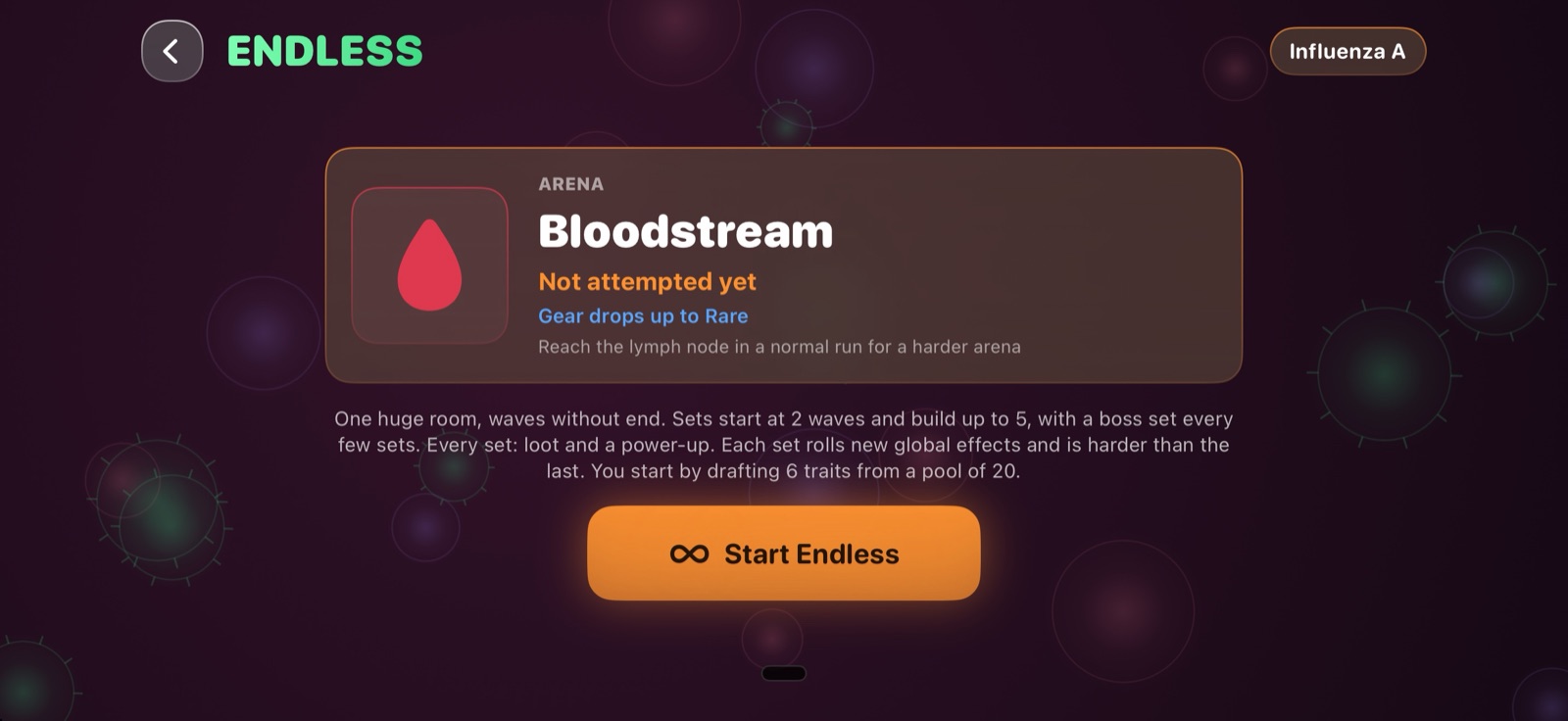

Fight wave after wave in the deepest organ you've reached and see how long you last. Runs stand apart from your lineage, so dying here never ends a generation.
One big sealed room set in the newest organ your virus has reached, and just as hard. Reach deeper organs in normal runs for harder arenas, each keeping its own best record.
Every Endless Game Mode run opens with a trait draft, just like a deeper start. Deeper arenas roll rarer traits, duplicates stack, and Pick for me fills your picks when you're in a hurry.
Each set opens with a card of its rules and a short countdown, then its waves. Clear every cell and loot drops in the middle while you choose a new trait.
Sets start small, with only a couple of waves, and build up to longer ones, with a boss set arriving every few sets to break up the rhythm.
Every cell arrives already hunting you, drawn from the organ's own mix, and the mix grows as you climb. Antibody swarms join each wave, getting bigger set by set.

Every set is harder than the last, on top of its own rules. Cells get tougher, hit harder, move faster and turn elite more often, and the set card tells you how much.

Each set rolls fresh global boons and curses that last until the next one. Boons stay few while curses pile up as you go, so every set feels different.

A boss set pits you against one boss from any organ you've reached, never the same one twice in a row. Its health scales with your build, and beating it pays extra loot.

Every cleared set pays nucleotides, materials and gear of the arena's level, plus Ribozyme Cores, and heals you a good chunk. Boss sets add better gear and more cores.
The material that enhances gear past its early levels, with each level needing more. Every set pays some, and Endless bosses, Killer T cells and elites drop extra.
Every set raises a new layout of tissue walls to hide behind, bounce shots off and funnel cells, from pillars and bars to a diamond. Layouts never repeat back to back.
The run summary counts the sets you survived, then a final page sets your result against your best. Any gear found can be reviewed, equipped or dismantled as usual.
Endless Game Mode
Each set rolls its own global effects from this list. Boons help you, while curses make the immune system stronger.

A boon that makes your hits land critically more often. Every shot has a better chance of dealing big damage for as long as the set lasts.
A boon that toughens your outer layer, so you take less damage from everything the immune system throws at you until the set ends.
A boon that turns your auto-attacks into healing. A small slice of the damage you deal comes back as health, so steady shooting keeps you topped up.
A boon that brings your health back on its own, moment by moment, so you can recover between waves without hunting for a heal.
A boon that coats you in spikes: any cell that touches you gets hurt, punishing the immune cells that try to crowd in close.
A boon that brings your dash back sooner, letting you slip out of trouble more often and stay on the move through crowded waves.
A boon that makes your shots fly faster, so they reach distant cells sooner and moving targets have less time to escape.
A boon that leaves more to collect. Kills and clears drop extra nucleotides, padding your haul for upgrades between runs.
A boon that heals you with every kill, rewarding aggressive play: the faster you clear a wave, the more health you claw back.
A boon that makes dying cells burst and hurt their neighbours, so one kill in a tight cluster can tear through the whole crowd.
A boon that pulls pickups to you from much farther away, so you can grab loot without breaking off from a fight.
A curse that speeds up the immune cells. They close in faster and are harder to outrun, so keeping your distance takes more work.
A curse that makes immune cells hit harder. Every touch and shot that lands costs you more health, so careless mistakes add up fast.

A curse that toughens the immune cells, giving them more health. Waves take longer to clear and each cell soaks up more of your fire.
A curse that speeds up enemy shots. Incoming fire crosses the arena faster, giving you less time to spot it and dodge.
A curse that lets wounded cells heal over time. Spread your damage around and they'll recover, so it pays to finish targets off.

A curse that fills the arena with elite cells, far more than usual. Expect tougher foes with their own tricks throughout the set.
A curse that makes the immune system notice you sooner. Detection rises much faster and cells see farther, so slipping past unseen gets far harder.
A curse that makes dying cells burst, and those bursts can hurt you. Finishing cells off up close becomes risky, so keep some distance.
A curse that thins out your haul. Kills and clears leave fewer nucleotides behind for as long as the set lasts.
A curse that weakens your shell so you take more damage from every hit. Mistakes cost more, and dodging matters more than ever.
A curse that makes cells bigger and meaner, with more health and harder hits at once, pressing on your offence and your defence together.
Encyclopedia
A real-science encyclopedia of everything in the game. Most entries are discovered as you play, each pairing real biology with a fun fact.
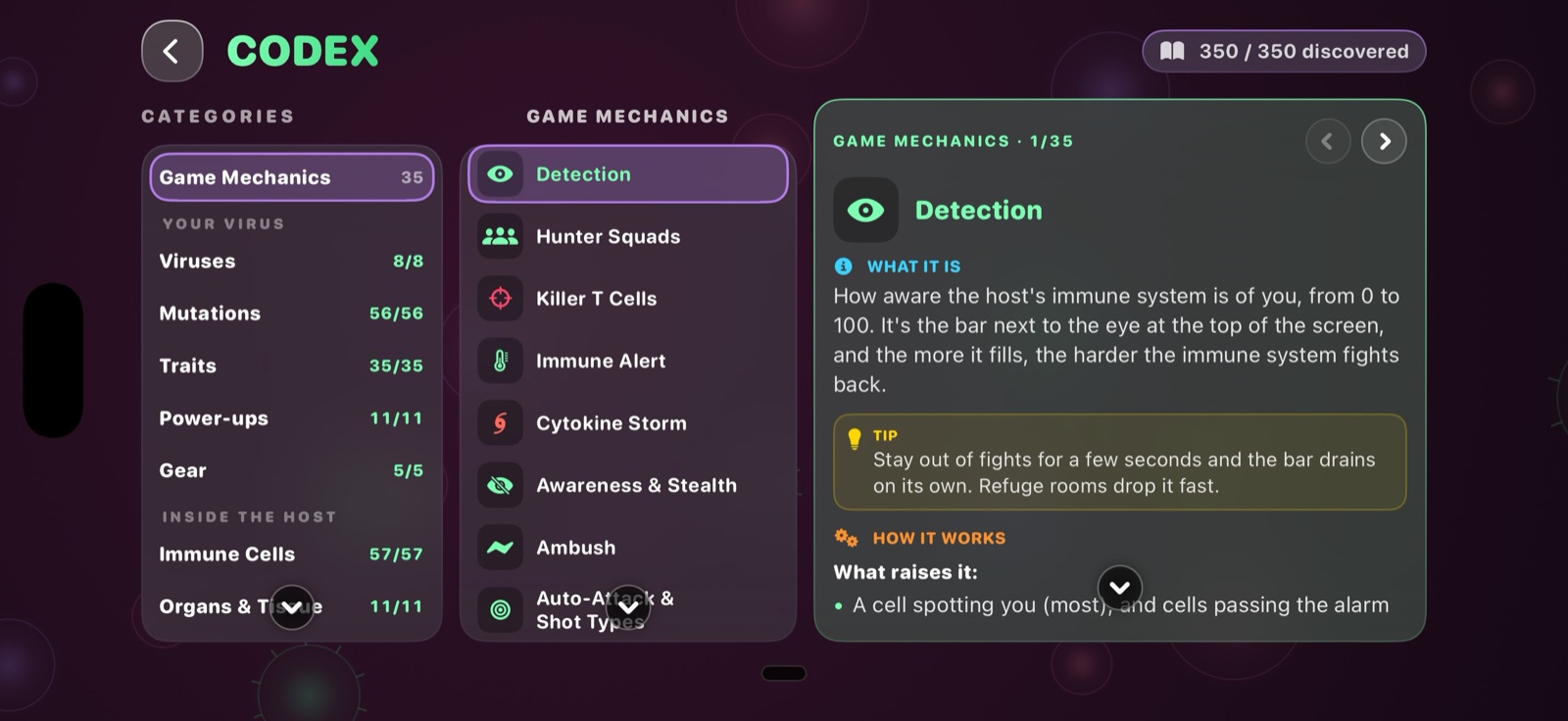
Categories on the left, entries in the middle and the entry to read on the right. Undiscovered entries show a silhouette and a hint, and the Codex opens once you finish a run.
How the game's systems work, from Detection and Killer T Cells to Run Modifiers and Pandemic Game Mode Responses. Always readable, with each entry appearing once its mechanic has been introduced.
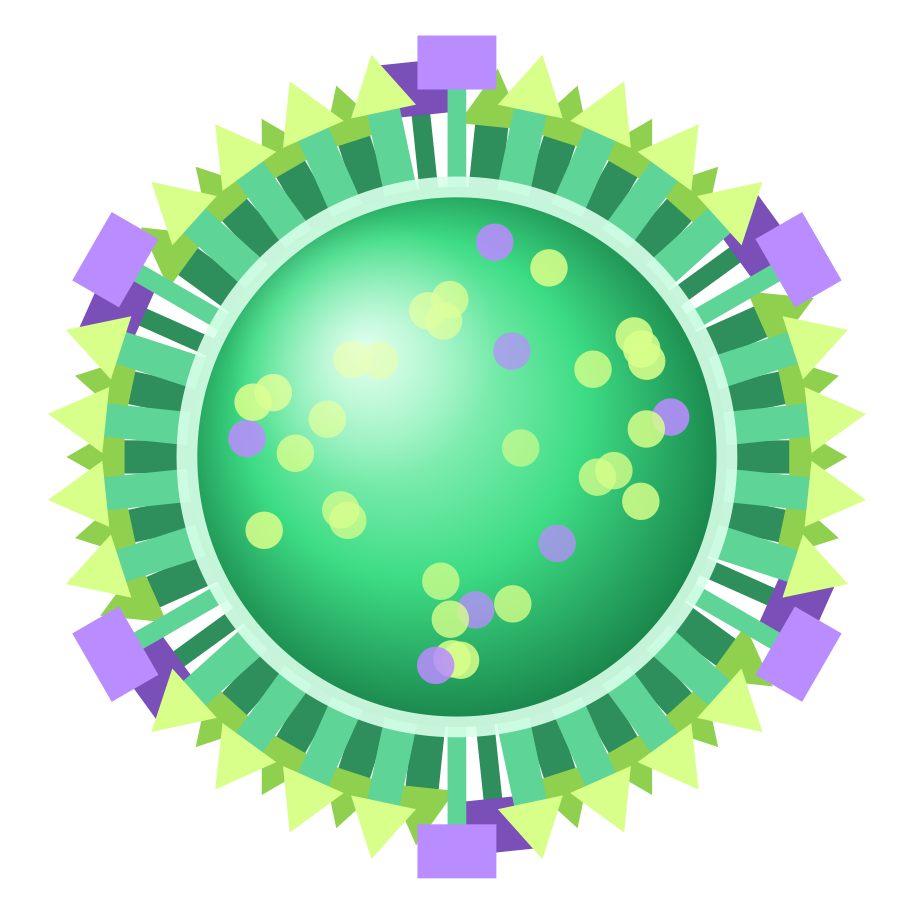
The playable viruses, the rival viruses and the virion itself, from Influenza A to Rhinovirus and Norovirus. Found by playing one, meeting it as a rival, or mutating into it.
Every strain a generation can be born with, from Robust Capsid and Twin Genome to Glass Cannon. Each one unlocks when you pick it for a new generation.

Every trait a mutation orb can offer, such as Lytic Burst, Fomite Ricochet and Gene Drive. Each one unlocks the first time you pick it in a run.

CRISPR and the elemental power-ups, from Chain Lightning and Fire Cross to Frost Aura and Umbra. Each one unlocks when you pick it up in a fight.
The gear slots and the real viral parts behind them: Capsid, Viral Envelope, Matrix Protein, Tail Fibers and Spike Protein. Each unlocks when you find gear for that slot.
Every cell that fights you, from neutrophils and macrophages to bosses and tumors like Glioblastoma. For most cells, landing a single hit is enough to add them.
The eight organs plus the mucus, cilia and alveoli you meet inside them. Each one unlocks when you reach that part of the body in a run.

Special rooms and the hazards built into the tissue, like the Refuge, Receptor Puzzle, Immune Siege and Abyss Pits. Each unlocks the first time it shows up in a run.
The medicine your host takes to fight you, from Oseltamivir and the Influenza Vaccine to Interferon Shots and Radiation Therapy. Each unlocks when the host takes it during a run.
Conditions a person or animal host can carry, each changing the whole run, from Severe Asthma to White-Nose Syndrome. Each unlocks when you infect a host that has it.
Proteins and molecules from the game, from antibodies and Hemagglutinin to Histamine and RNA. Each unlocks when it turns up in a run as a drop, a gene or an attack.

Biology in action, like Opsonization, Antigenic Shift, Phagocytosis and Viral Latency. Each one unlocks when it happens to you or around you during a run.

Every animal you can infect, each with its own signature trait, from fruit bats and pigs to kangaroos and penguins. Some only live around Pandemic Game Mode cities.
Every city in Pandemic Game Mode, with a real outbreak or event from its history, its standing policy and what it becomes once taken. Each unlocks when you start a run there.
Play your way
Play with touch, a controller, or keyboard and mouse, in English or Spanish. Every menu works without touching the screen, and the game respects Reduce Motion.
Put a thumb down on the left side to steer with a floating stick, and tap the round buttons on the right for your moves. Your virus fires on its own at the nearest visible cell.
Xbox, PlayStation, Switch Pro and MFi controllers work in runs and in every menu. Connect one at any time, even in the middle of a run, and keep playing.
Give each run action, from Dash to Pause, any controller button you like. Picking a button that's already taken swaps the two, and changes made mid-run apply at once.
On-screen prompts show the buttons of the controller you're actually holding, in their real colours, and switch to keyboard keys whenever you last used the keyboard.
Every menu can be played without touching the screen: a spinning highlight moves between buttons, shoulder buttons switch tabs, and even locked items can be highlighted to see what they need.
With a controller or keyboard in use, a bar along the bottom shows what each button does on the current screen, listing only the hints that apply right now.
Any hardware keyboard plays, whether it's a Mac's, an iPad's or a Bluetooth one on iPhone. Arrow keys move, Space dashes, and single letter keys fire your skills.
Menus work from the keyboard too, with the same highlight as a controller. Arrows or WASD move, Return selects, Esc goes back, and Settings lists every key.
Steer with the pointer: hold the left button and your virus heads toward it, reaching full speed once the pointer is far enough away. Right-click to dash.
Every sound in the game has a matching vibration: light taps for hits and pickups, heavy thumps for damage, and double pulses for rewards and warnings, never a constant buzz.
One panel, reachable from the main menu or the pause menu, for music and effects volume, vibration, language and controls. Everything you change is saved between launches.
Play in English or Spanish, or simply follow your device's language. Numbers and dates follow the game's language, and the switch applies after restarting the game.
With iOS Reduce Motion on, the game calms its busiest animations, from the title screen's intro to the Pandemic map's moving layers, while buttons keep their labels for VoiceOver.
Briefings and confirmation pop-ups hold their main button for a brief countdown, so a finger still on the screen can't dismiss them by accident. Cancel buttons are never held.
Tap something you can't afford or can't use yet and it shakes and tells you why, with a denied sound and a buzz. It works the same with a controller.
Progress saves on its own moments after anything changes and whenever the app goes to the background. Pickups and discoveries are banked every few seconds during a run.
The Mac version adds window scaling, so the interface can grow with the window or stay pixel-sharp, plus game-styled sliders and switches and keyboard and mouse that are always on.
Sound and look
Every sound and note in Pathogen is synthesized from code, with no audio files. The music adapts to the fight, and each organ has its own theme.
A tiny built-in synthesizer renders every sound effect and music loop when the game launches, using oscillators, filters and echo, with gentle saturation so stacked sounds never clip harshly.
A sound for everything that happens, from each shot and pickup to a boss falling. Influenza A and Retrovirus even have their own shots, and small pitch changes keep repeats from sounding robotic.
Each theme is built from layers that fade in and out as the action heats up: fights bring in the bass and drums, and boss rooms bring in everything.
The calm opening theme that greets you on the title screen, a slow Lydian tune built from a soft triangle pad and a gentle sine lead.
Plays on every screen between runs: a lightly swung Dorian groove with a saw pad and a triangle lead, easygoing while you upgrade.

The first organ's theme, a swung Dorian tune with a saw pad and a triangle lead that sets the tone as your infection begins.
Airy and open, the Lungs theme moves in a minor key with a soft triangle pad and a sine lead floating on top.
Fast and tense, the Bloodstream theme drives forward in harmonic minor with a saw pad and a biting square lead.
Swinging and busy, the Lymph Node theme is a swung Dorian tune with a saw pad and a triangle lead, as lively as the immune hub it plays in.

The darkest theme, with the heaviest swing: a Phrygian tune with a saw pad, a square lead and the most muffled filter in the game.

Brooding and low, the Liver theme sits in a minor key with a triangle pad beneath a saw lead, setting a darker mood deep in the host.

The fastest organ theme, a harmonic minor rush with a saw pad and a square lead that pushes the pace as you near the end.
The brightest theme, saved for the final organ: a Lydian tune with a triangle pad, a sine lead and the most open filter in the game.
A short, driving loop that takes over while CRISPR makes you invincible, with pumping bass, a gritty saw riff and power-chord stabs, before handing back to the organ's theme.
Every run opens with INFECTED slamming in over a green pulse, with a vibration to match, whether you're starting Infect Game Mode, Pandemic Game Mode or Endless Game Mode.
A night-and-day world with drifting oceans, glowing coasts and infection spreading city to city, plus aurora ribbons over Antarctica and a spinning globe in the header.
The city's people flip red one by one with a tick and a light buzz, response cards flip in, and a FALLEN stamp lands with a heavy thump of vibration.
At the start of each organ in a Pandemic Game Mode run, a banner lists the city's responses in force, good ones in green and bad ones in red.
Next up
Four viruses that play nothing alike, plus rivals that want your host.